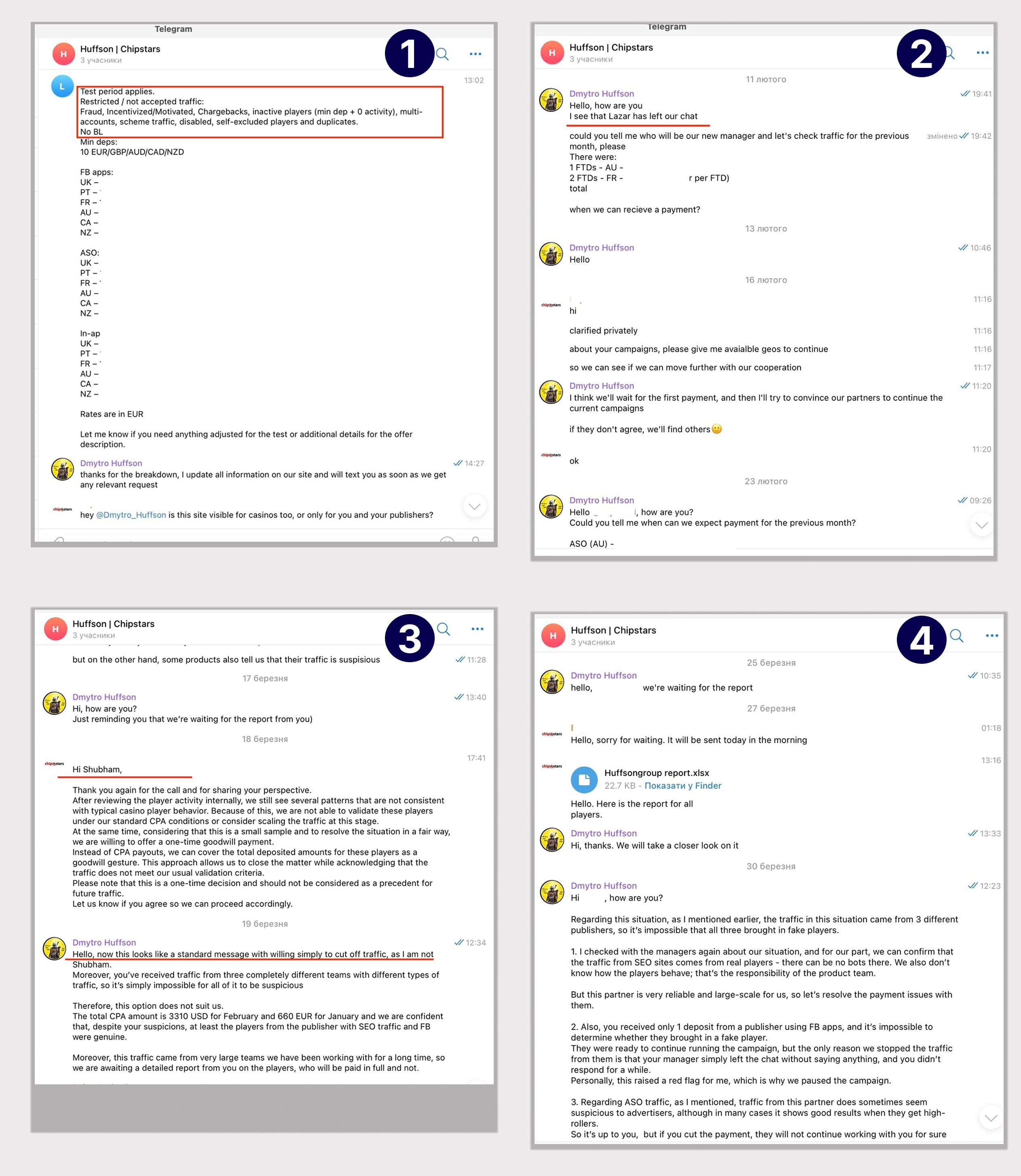
In early 2026, Huffson Group launched a partnership with Chipstars Affiliates (Chipstars brand), bringing in three independent media buyers across different traffic sources - ASO, Facebook, and SEO. All terms were agreed upon upfront. The total earned payout came to $3,310 + €660.
Instead of paying, the advertiser first ghosted, then started introducing new requirements that never existed at campaign launch.
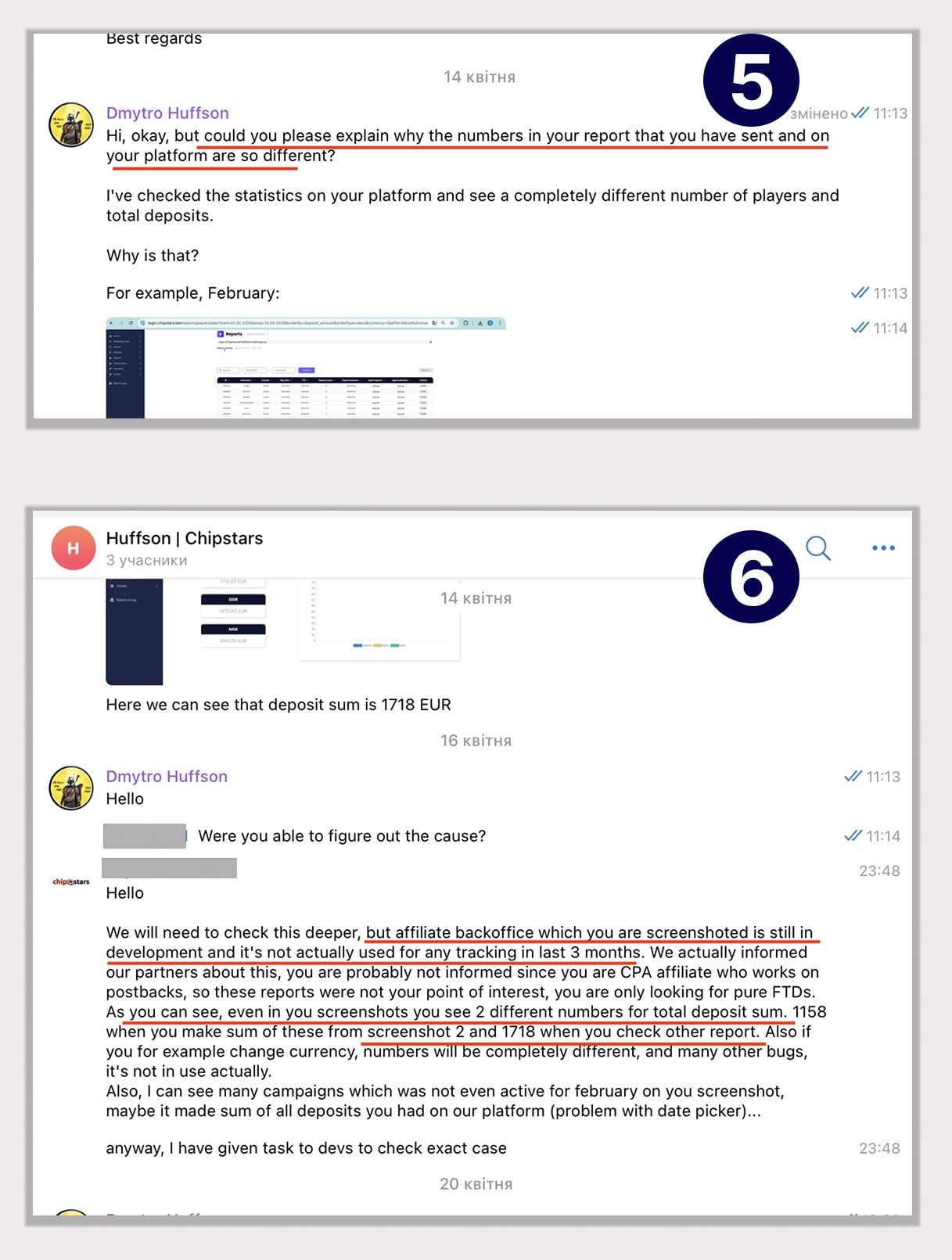
During the review, it emerged that Chipstars' own platform had not been used for CPA tracking for at least three months due to multiple bugs - none of which partners were informed about. The only "proof" of traffic quality the advertiser could produce was a manually edited Excel file.
Huffson Group considers the non-payment unjustified and is sharing a full timeline of events.
*** Timeline
January 2026
Partnership kicks off. Huffson onboards a partner running ASO traffic.
February 2026
Huffson brings in two more partners - Facebook and SEO.
Terms agreed with the advertiser at launch:
Test period applies.
Restricted / not accepted traffic:
Fraud, Incentivized/Motivated, Chargebacks, inactive players (min dep + 0 activity), multi-accounts, scheme traffic, disabled, self-excluded players and duplicates.
No BL
Min deps: 10 EUR/GBP/AUD/CAD/NZD
Final results: ASO - 3 FTD, FB - 1 FTD, SEO - 11 FTD.
Total payout: $3,310 + €660
One Chipstars manager leaves the chat without explanation. A second manager goes completely silent.
Huffson pauses all campaigns and attempts to re-establish contact.
Once contact resumes, Chipstars proposes a call - where they claim all traffic is “motivated”.
Huffson pushes back and requests a per-stream breakdown, since the traffic came from three entirely different teams with different sources.
March 2026
Chipstars delivers an Excel report with a set of post-hoc rejection reasons: "too small amount", "low bet count doesn't meet our expectations", "the player didn’t ask to withdraw", " traffic does not meet our usual validation criteria". None of these KPIs were part of the original agreement.
April 2026
Huffson cross-references the Excel data against Chipstars' own platform - and finds significant discrepancies in both player count and deposit volume.
Chipstars' final offer: a "one-time goodwill payment" - three times less than what their own platform shows. In doing so, they admit the platform hasn't been used for CPA tracking in 3 months, is riddled with bugs, and has been handed back to devs for fixes. None of this was disclosed before or during the campaigns.
*** Huffson Group's Position
Huffson Group fulfilled every agreed condition and is demanding full payment of $3,310 + €660, based on the following:
Unreliable evidence base. Chipstars is refusing CPA payouts citing "traffic quality issues" while simultaneously admitting their own tracking platform is broken and wasn't being used. The only thing they can put on the table is a manually edited spreadsheet. That's not a basis for rejecting a payout - that's a red flag.
Post-factum KPIs. Requirements around wager volume, session count, and deposit thresholds appeared only after traffic was delivered. At launch, there was a standard restricted list and nothing else. No additional criteria were agreed upon.
Flawed traffic evaluation. Three different sources - ASO, Facebook, and SEO - were lumped together under a single verdict: "motivated traffic". Anyone who's ever run media buying knows these sources have completely different user behavior patterns and need to be evaluated independently.
Behavior as a red flag. Huffson pulled the plug on campaigns the moment the advertiser's behavior turned suspicious — one manager quietly left the chat, another went dark. That's exactly why the final volumes are small (3, 1, and 11 FTDs). Assessing traffic quality on numbers this low is meaningless.
Huffson Group remains open to a genuine resolution, but considers Chipstars' current position manipulative and in bad faith. Moving the goalposts after delivery, using a broken platform as an argument, and systematically dodging communication are not acceptable practices - with any partner.
Chipstars Affiliates would like to clarify several points regarding this case.
First, the reporting inconsistencies mentioned by Huffson were related to a temporary backoffice display issue, not to the underlying tracking or player event data itself. During the entire cooperation period, deposit events were tracked and shared via postback integrations in real time, including with Huffson’s team directly.
Second, CPA qualification is not determined solely by the number of deposits or FTDs. As with any affiliate program, all traffic is subject to internal fraud prevention, traffic quality analysis, and player behavior validation. This includes evaluating activity patterns beyond the initial deposit event.
After detailed internal review, the traffic in question did not meet our internal CPA validation standards. This decision was based on a broader assessment of player quality and behavior, not on isolated metrics introduced “after the fact.”
At the same time, despite our position regarding CPA qualification, Chipstars offered a one-time goodwill payment covering deposited amounts in an attempt to resolve the matter fairly and avoid unnecessary escalation.
We remain open to professional communication, but we reject the implication that the decision was made arbitrarily or without supporting internal analysis.
When this payment dispute arose, we reviewed our previous conversations with your former manager and found that Chipstars had the exact same technical problems with your platform back in 2024. It is disappointing that two years later, the issue remains unresolved - and yet it is now being used as a justification for non-payment.
Describing it as a "temporary backoffice display issue" does not change the underlying fact: your own platform cannot be relied upon as a source of truth. Framing a long-standing, unresolved technical problem as a one-off display glitch looks less like an explanation and more like a convenient excuse.
We also want to draw attention to a clear discrepancy between the deposit amounts in your Excel report and the figures shown on your own tracking platform — the platform numbers are significantly higher. We have screenshots confirming this. We have no way to independently verify which figure is accurate.
* Accepting a manually edited spreadsheet as the sole basis for a payment decision is not a constructive approach, and a situation where reported figures are consistently lower than platform data, with no transparent explanation, is what the industry typically calls "shaving".
Regarding the fraud accusation: this was a test campaign, and no KPIs, baselines, or additional requirements were communicated before we began working together. You now accuse us of fraud without providing a single specific marker or criterion to support that conclusion. We understand that fraud markers are not typically disclosed publicly — that is standard industry practice.
But we would ask a straightforward question: how is it methodologically possible to assess traffic quality and label an entire stream as fraudulent when one of the flows produced just 1 FTD?
That is not analysis — that is a verdict without evidence.
The agreed terms of cooperation are documented. Your manager Lazar provided separate tracking links for each traffic source, and stated the following conditions in the same conversation: "We would just like to keep soft KPIs: Fraud Traffic, Motivated (Incentive) Traffic, Chargebacks, inactive (min dep and 0 activity), Multi, Scheme Traffic, Disable, Self-excluded and Duplicates. Is that fine?" That is the complete list of restrictions that was agreed upon — nothing more.
No volume caps were set. No KPI. No additional requirements of any kind were communicated before, during, or after the launch. The terms were clear, and we operated within them.
Test traffic is meant to be paid for. That is the entire point of a test: the advertiser evaluates the results and then decides whether to continue the partnership or not.
Finally, we want to note that the conduct of your representatives throughout this cooperation has been unprofessional. One manager left the chat without explanation, another ignored messages for extended periods, and names have been confused in correspondence. Reading through the full exchange, your responses read as copy-paste templates rather than a genuine, individual review of our specific case. That falls below the standard of professional communication in any business partnership.
I have attached screenshots showing the difference between the total deposit amount and the number of deposits on the platform and in the Excel report
We are confident that the traffic we delivered consisted of real players and we expect full payment: $3,310 + €660.
screenshots:
https://prnt.sc/1XZqldsD6Ol8
Total report
https://prnt.sc/WIrVQ2O5bhtX
We would like to clarify several inaccurate assumptions being presented in this thread.
The issue referenced regarding the affiliate backoffice was related to reporting display inconsistencies, not to the underlying player tracking itself. During the cooperation period, all deposit events were tracked and shared through postback integrations in real time, including with Huffson directly.
At no point was CPA validation based solely on the affiliate backoffice interface or on a "manually edited spreadsheet", as repeatedly implied here. Internal traffic validation uses multiple data points and internal monitoring systems beyond what is visible in the affiliate panel.
Regarding the claim that “new KPIs” were introduced afterwards: CPA agreements are always subject to traffic quality review, fraud prevention checks, and internal validation standards. The restricted traffic definitions shared at launch were examples of explicitly prohibited traffic categories, not an exhaustive list of all internal evaluation methodologies.
We also reject the implication that this was a “shaving” situation. Chipstars already offered a goodwill payment covering deposited amounts despite our conclusion that the traffic did not qualify under our internal CPA validation standards.
At the same time, we acknowledge that communication during this case could have been handled better on our side, particularly regarding response delays and management transitions.
Our position regarding the traffic quality itself, however, remains unchanged.
1. The screenshots below clearly show the difference between the statistics on the Chipstars platform and the data provided in the Excel report
You can see the difference in the number of FTDs and the total deposit amount
2. Let’s be honest – Chipstars offered a payout based on the deposit amount, which in their report was around €530, although the platform clearly shows a deposit amount of €1,718
Furthermore, the number of FTDs in the report and in what they sent to our tracking system is half of what is actually on their platform.
This is direct proof that Chipstars are simply shaving off a part of the traffic.
We need to clearly reject the accusation of “shaving”.
The screenshots referenced show differences between the affiliate backoffice display and the final validation report. As already explained, the affiliate backoffice had reporting/display inconsistencies during that period and was not used as the source of truth for CPA validation.
CPA validation is not based on simply taking every number visible in the affiliate panel and treating it as payable. It is based on tracked player events, postback data, internal records, fraud prevention checks, and traffic quality review.
The goodwill amount offered was a commercial attempt to resolve the dispute fairly despite our conclusion that the traffic did not qualify for CPA payment.
We also want to clarify that differences between gross activity shown in a reporting interface and final validated CPA results do not constitute “shaving”. Shaving would imply intentionally hiding valid payable conversions. That is not the case here.
Our position remains the same: the traffic was reviewed internally, did not meet our CPA validation standards, and therefore full CPA payout cannot be approved.